
Skip to content

Guide

What is productization? The AI-era guide for B2B firms

How B2B professional services firms turn expertise into standardized, repeatable offerings — and why AI raises the stakes on getting it right.

The short answer

Now that AI is built into most workstreams, clients increasingly expect you to deliver your services for less, or to deliver more for the same price. That expectation puts direct pressure on your billable hour: when a deliverable takes days instead of weeks, a price built on time can only fall. By turning your services expertise into standardized, repeatable offerings with a defined scope and a set price, you can price by the outcome rather than the hours it took, enabling the speed AI gives you to widen your margin instead of shrinking it. We define that shift as productization. This guide explains what it means for B2B services firms, why AI raises the stakes, and how to choose, validate, price, and sell your first productized offering.

01

What is productization?

Productization begins with the expertise your clients are already purchasing, packaging that expertise into a named offering with a defined customer, scope, set of features and benefits, price, and delivery method. Defining those dimensions makes the offering easier to repeatedly sell and deliver.

Productization can take several forms, but primarily exists through service-led models. A productized service still depends on your people, but uses a standardized delivery model that requires fewer resources to sell and deliver than a bespoke engagement.

Across all forms of productization, your intellectual property provides its substance, while technology supports its scale, and the actual service behind it delivers the value to your client. The proportion of each ingredient changes with the offering. That flexibility supports formats as varied as a standardized workshop, a methodology paired with a data tool, and a renewable subscription.


02

Why does productization matter more in the AI era?

AI can shorten your delivery time, support more personalized experiences, and open new ways to deliver services. Those gains create more room to scale. At the same time, they expose the limits of pricing models tied to hours or internal cost.

When delivery becomes faster, a cost-based model pulls the fee conversation toward your time instead of your client's result.

Productization gives your firm a defined offering and a clearer unit of value. The same expertise can then be sold through a fixed fee, tiers, a subscription, or another model that fits how your client receives value. While the offering itself may remain familiar, you change how you package, deliver, and price that expertise.


03

What will clients continue to pay for?

At Vecteris, we start with four reasons an organization hires a services firm. Even as AI changes how each need can be met, the reasons themselves remain.

01

Capacity or speed

Clients need more capacity or speed. AI can automate more of the delivery and make a tailored experience possible at greater scale.

02

Skill or experience

Clients lack skill or experience. AI can expand training and support, while experts still validate outputs and apply judgment to the client’s circumstances.

03

Third-party independence

Clients need third-party independence. AI can surface risks and anomalies faster. Even then, an accountable advisor still has to own the recommendation.

04

Cross-company perspective

Clients need a broader cross-company perspective. AI can synthesize larger data sets, while proprietary data, context, and interpretation remain sources of value.

These needs point toward offerings that combine technology with the judgment, independence, and intellectual property your firm already provides. Productization makes that combination easier for your clients to understand and buy.

Go deeperWhat clients still pay for when they think AI can do it for them — coming soon

04

Where does your firm sit on the Product Innovation Ladder?

The Product Innovation Ladder maps how distribution, delivery, and pricing change as your firm moves toward more scalable offerings. You can stay on one rung, move gradually, or combine offerings from several rungs in the same portfolio.

Vecteris Framework
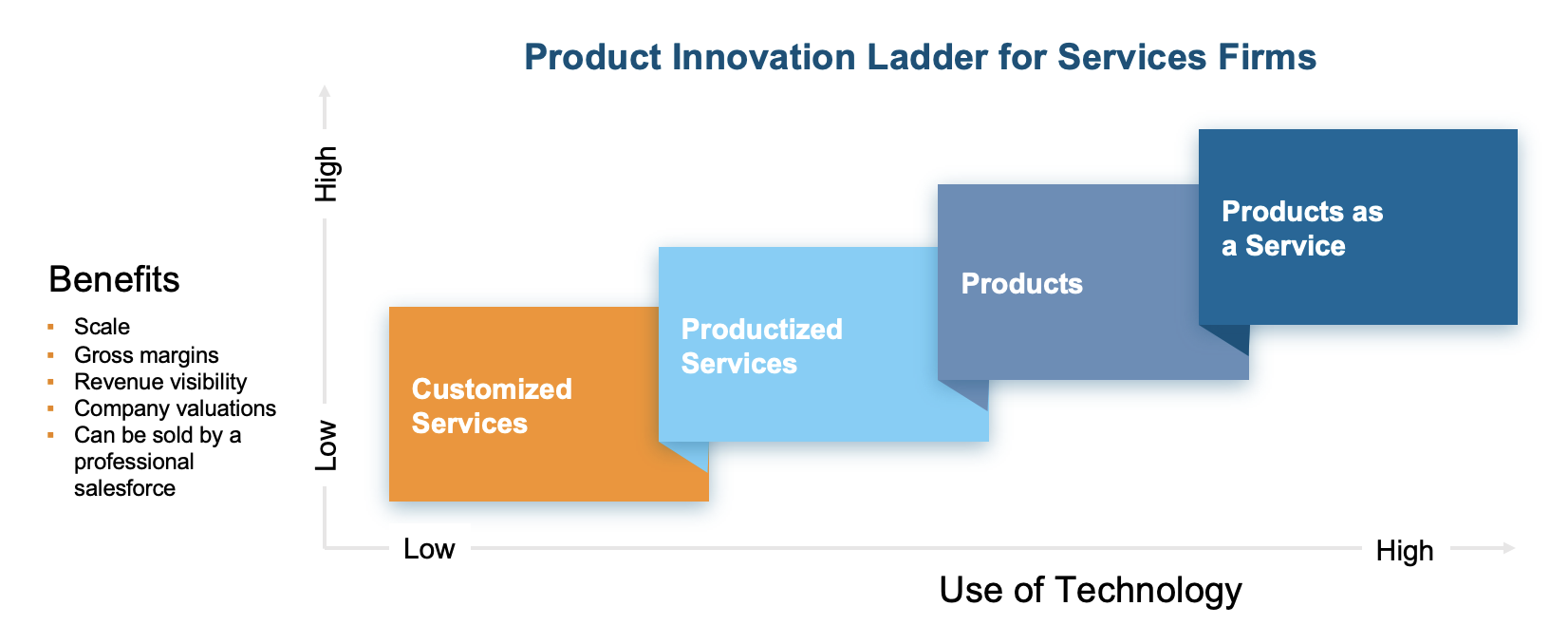
The Product Innovation Ladder

Rung Distribution How it is delivered How it is priced Examples
Customized Services One-to-one Tailored, human-powered delivery for each client Time-and-materials, project, or retainer Consulting engagements, agency services
Productized Services One-to-one Standardized, human-powered delivery, often supported by technology Transactional per-offering pricing, sometimes with service levels Predefined workshops, service packages, training sessions
Products One to many Created once and delivered repeatedly without human intervention for each sale Transactional Conferences, asynchronous courses, syndicated research
Products as a Service One to many Tech-led, with ongoing access to standardized information or tools Subscription Data as a service, learning as a service, memberships

Technology tends to carry more of the delivery higher on the ladder, which can improve your gross margins and revenue visibility. AI also makes it easier to combine rungs. You might pair a standardized data offering with premium advisory, preserving human judgment where it adds the most value.


05

Why do new offerings stall?

New offerings primarily tend to stall when you start too big, develop without evidence of an urgent and expensive customer problem, designs in a vacuum, or treats the first release as finished. Read our blog on the Seven Deadly Productization Mistakes for a deeper dive on the topic.

AI can make your concept or prototype look polished earlier in development. That speed is useful when it supports more customer testing and shorter iteration cycles. However, polish can create a false sense that the offering is ready before prospective buyers have tested it.

In practice, polish is what fools people. We watch teams fall for their own prototype: it looks finished, so the customer testing quietly gets skipped, and the offering launches before anyone has confirmed a buyer wanted it. Speed only helps if it buys you more testing, not less.

When your offering stalls, return to the customer and the problem you are solving for them. Then build the value proposition, price the offering around value, and use market evidence to refine or pivot. That sequence uses AI to accelerate learning while keeping your investment tied to demand.


06

How do you productize a service?

The Productize Pathway® gives your B2B services firm a repeatable method for developing and managing scalable offerings. The sequence begins with Align, while Creating a Product-Friendly Culture sits at the center and supports every step.

  1. Align. Set aside resources, establish separate measures for new offerings, and make portfolio decisions as AI changes which capabilities remain worth funding.
  2. Define the (Right) Problem. Identify an urgent and expensive problem in an attractive segment. AI can synthesize interviews and support data, while direct customer discovery provides the context behind the evidence.
  3. Co-Design and Develop. Build and test concepts with customers and colleagues outside the core team. AI can accelerate prototyping and simulated feedback, while customer testing confirms whether the offering solves the problem as intended.
  4. Launch Boldly. Establish the positioning, pricing, sales plan, and delivery method. AI can open new delivery options, which makes a focused launch and a clear value proposition more important.
  5. Manage and Iterate. Measure adoption, customer value, and portfolio performance. AI can compress iteration cycles, while ongoing customer evidence keeps a polished early release from being mistaken for a finished offering.
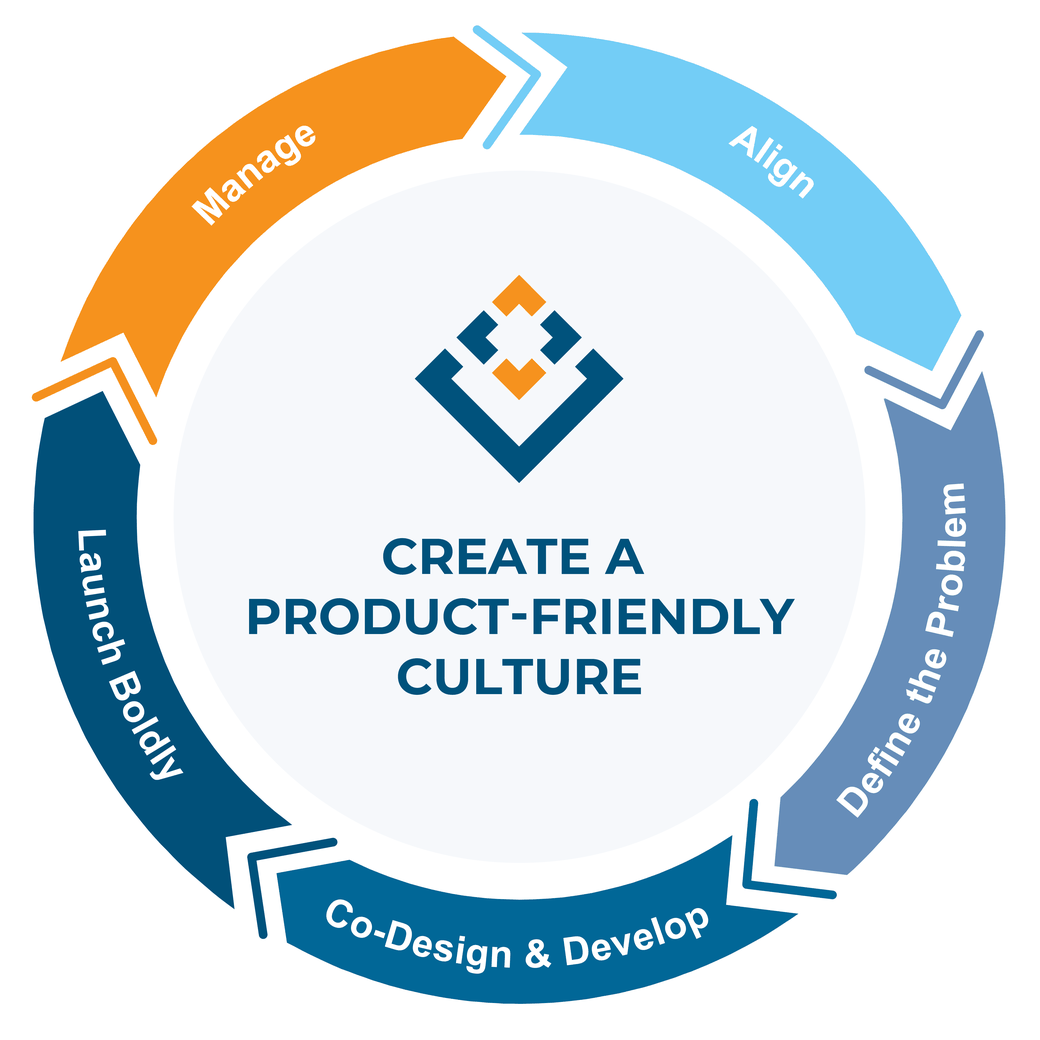
The Productize Pathway: five stages arranged in a circle - Align, Define the Problem, Co-Design and Develop, Launch Boldly, and Manage around a center labelled Create a Product-Friendly Culture.
The Productize Pathway®

At the center: Creating a Product-Friendly Culture

This develops alongside that sequence through the skills, incentives, structures, and communication that support productization. As a result, your process and people advance together.

Free diagnostic

Productize Maturity Diagnostic

Assess your current strengths and development areas across the five stages of the Productize Pathway®.

Take the diagnostic
07

How do you validate demand beyond one client?

One enthusiastic client is not evidence of a market. Before you build, form hypotheses you can test, run 10 to 12 customer interviews across two or three segments to confirm you have an urgent and expensive problem and the addressable market is large enough to matter. Inexpensive tests belong before expensive builds. For many B2B studies, 10 to 12 well-chosen interviews can provide enough depth to identify patterns. Review the evidence after every few conversations and refine the interview guide as your understanding changes. Our customer interview article explains that method. The Productization Tools include interview guidelines, customer insight tracking, and an advisory board toolkit.

AI can synthesize interview notes, support tickets, and early hypotheses. Although those uses can speed analysis, direct customer conversations still reveal the context behind a buying decision. Follow the interviews with a sell-then-build offer, a concierge pilot, or a prototype before making a larger investment.

Go deeper How to validate a new offering beyond your first client — coming soon

08

How should you price a productized offering?

Value-based pricing begins with the economic value your client receives, including higher revenue, greater productivity, lower cost, or reduced risk. Your delivery cost still matters because it establishes the floor for a profitable offering. Customer value then informs the price above that floor.

In practice, the hard part is not choosing the model. It is holding the line when questions come up. When delivery gets faster, clients feel it, and the fee conversation drifts back toward your hours unless you have anchored it to the result you produce.

Once the value is clear, you can choose among fixed-fee, tiered, subscription, and usage- or outcome-based structures. Tiers may make most sense when you serve buyers with distinct needs and budgets, while subscriptions fit ongoing needs and usage pricing fits a unit that genuinely tracks value.

Our guide to value-based pricing explains the four models and the transition from time-and-materials. Four Critical Inputs for Pricing Your Productized Offerings goes deeper on strategy, customer value, full cost, and competitive context.


09

How do you help your team sell it?

The measures and incentives you use for customized services can make a new offering harder to sell. Utilization and short-term revenue reward established delivery, while a new offering initially needs customer evidence, learning, and adoption. You can support the change by measuring the offering according to its maturity and rewarding the behaviors required to develop its market.

Your sales team also needs a defined customer, a clear value proposition, evidence from early customers, and compensation that reflects your growth strategy. Higher commissions on subscription sales can redirect attention toward renewable revenue, while customer stories can show your consultants how the offering strengthens the relationship.

Can Incentives Help You Productize? explains how discovery, collaboration, and product-specific measures support the change. If existing revenue is your concern, the 3 Cs of Cannibalization walks through how to compare customer segments and identify complementary offerings.Go deeper How to get consultants to sell a productized offering — coming soon

Evidence

Turning Consulting Expertise into Scalable Growth & a Strategic Exit

Finit Solutions set out to move beyond custom consulting. Through the Productize Pathway® Advisory Subscription they launched three SaaS products on the OneStream™ marketplace, then productized their post-implementation support into Expert Answers — a tiered membership that replaced ad-hoc billable hours with predictable, recurring revenue. Codifying the expertise, aligning the teams and changing how the work was billed turned a project business into a product business.

I view you all as an extension of our team. Vecteris provides that vote of confidence that assures us we’re making smart decisions as we evolve our products and go-to-market.Jay Hampton, Managing Partner, Finit Solutions

$1M+

Annual recurring revenue

Within 24 months

52

Customers on Expert Answers

By end of 2024

Exit

Strategic acquisition by OneStream™

Full return on the productization investment

10

Frequently asked questions

Can a service be productized without becoming software?

A service can be productized through a consistent scope, delivery process, and price while remaining human-powered. Technology may support delivery while the service stays on the Productized Services rung of the Product Innovation Ladder.

How is productization different from standardization?

Standardization makes delivery more consistent, while productization packages that delivery as a defined offering with a price, a target customer, and a repeatable route to market.

How does AI change productization?

AI can shorten research, prototyping, delivery, and iteration cycles. It can also support more tailored experiences at scale. Demand still has to be established through customer discovery, while judgment, accountability, and continuous improvement protect the value of the offering.

How can a B2B services firm grow without adding headcount for every client?

A firm can package repeatable expertise into offerings that require fewer incremental resources to sell and deliver. Productized services, reusable intellectual property, data offerings, and subscriptions can all help revenue grow faster than staffing needs.

11

Where should you go next?

Use this pillar as the map, then follow the linked articles for the mechanics behind each decision. If you need to identify the capabilities that deserve attention first, the Productize Maturity Diagnostic will assess your current strengths and development areas across the Productize Pathway®.

How to productize your services: a six-step framework

A practical method for turning custom expertise into repeatable revenue.

How to protect revenue as AI shrinks the billable hour

Learn how services firms can price AI-supported services around client value.

What is a product? A definition for B2B services firms

Coming soon

What clients still pay for when they think AI can do it for them

Coming soon

Which services should you productize first?

Coming soon

How to validate a new offering beyond your first client

Coming soon

Free diagnostic

Productize Maturity Diagnostic

Assess your current strengths and development areas across the five stages of the Productize Pathway®.

Take the diagnostic