
Productized service pricing is a model that shifts professional services from hourly billing to fixed or tiered fees based on delivered value. Artificial Intelligence (AI) accelerates delivery, making traditional time-and-materials (T&M) models inefficient as they penalize providers for increased productivity. Adopting value-based pricing tiers allows B2B professional services firms to protect margins and align revenue with client outcomes rather than labor hours. Learning how to transition from hourly billing to value-based pricing is essential for firms looking to remain competitive in an AI-driven market.
Key Takeaways
- Productized service pricing shifts professional service models from hourly billing to fees based on delivered value.
- Artificial Intelligence accelerates project delivery, making traditional time-and-materials billing models inefficient for modern service firms.
- Firms must learn how to transition from hourly billing to value-based pricing to protect profit margins.
- Value-based pricing aligns revenue with client outcomes, decoupling firm growth from headcount and labor hours.
- Successful pricing strategies require analyzing customer willingness to pay, full delivery costs, and competitive benchmarks.
The time-and-materials model, the default in professional services for decades, is coming apart. A global legal services leader put it to us more bluntly: "Time and materials is dead." When AI lets your team deliver in five hours what used to take twenty, billing by the hour quietly punishes you for getting faster.
The shift to value-based pricing has been forecast for years. AI turned a slow evolution into this quarter's problem. Firms adopting early are not just changing billing methods; they are repackaging expertise into productized offerings with tiered, value-based pricing to protect their margin.
This is the framework for making that move: why hourly billing breaks, what replaces it, how to price it, and how to choose the model that fits your firm.
Why Time-and-Materials Pricing Fails for AI-Enabled Services
In our conversations with innovation leaders across B2B services, the message is consistent: AI is eroding the rationale for T&M pricing.
- One executive in HR advisory told us their firm is already adjusting consulting targets based on aggregate AI productivity gains, without changing billable rates yet.
- A global legal services firm said flatly that time and materials is dead.
- Consulting partners are piloting engagements where AI makes the deliverable better, and billing on the value delivered rather than the hours logged.
Why now? Because AI accelerates delivery without reducing the value the client receives. So clients are asking the obvious question: "If your team is twice as fast, why are we still paying this much?"
This question exposes the structural flaw in the time-and-materials (T&M) model. Under T&M, your revenue is tied to effort, and AI's whole purpose is to cut effort. Every efficiency you gain shrinks the invoice. You have built a model where getting better at your job costs you money. For productized offerings, where the value is the outcome, and we can deliver repeatability, hourly billing makes even less sense. Think of it this way: your clients are buying a result, not time on your calendar.
Strategic Advantages of Value-Based Pricing in Professional Services
Moving to a value-based pricing approach does more than just fix your invoicing problem. Moving to value-based pricing is so much more than a billing change; one client is calling it a “business model transformation,” and I couldn’t agree more. It may sound like an overwhelming shift, but the benefits are worth it:
- You can reach new buyers without discounting. You may now be able to build lower tier offerings that bring in clients who could never afford a full custom engagement, while your high-end advisory maintains its platinum-level pricing. Done right, tiers expand the market rather than cannibalize it. (How To Mitigate Cannibalization Risk From New Products.)
- Revenue gets more predictable and more renewable. Subscription offerings can convert what was once one-off projects into recurring revenue you can forecast and even expand.
- You decouple growth from headcount. Traditionally, in professional services, we scale by adding more people. Now by coupling AI with a productized approach, you can serve the next ten clients without ten new hires.
- Pricing becomes a sales enabler, not a negotiation. If you have the right tiers, based on your client’s actual buying habits, you get an easy yes and a shorter sales cycle.
Four Key Inputs for Pricing Innovative Productized Offerings
Pricing a productized offering means moving past T&M. T&M tells you what the work costs you. It tells you nothing about what the outcome is worth to the client. Value-based pricing starts from the client's side of the table. Four inputs build that picture.
1. Align pricing with your business strategy. Set the pricing foundation by aligning on strategy: what is the price supposed to do? Are we focused on driving fast adoption of a new offering, protecting a premium position, or offering an entry point that leads to larger work? Pricing has a job, align on that first.
2. Understand the value to the customer and their willingness to pay. (This is the most important!) Good pricing is built on the economic value the client receives: more revenue, higher productivity, lower cost, reduced risk. Validate it by talking to actual buyers directly. Techniques like Gabor-Granger and Van Westendorp surface the price points where an offering becomes attractive, and where it stops being credible. Test willingness to pay early, before you optimize for margin.
3. Account for the full cost to deliver, sell, and renew. It’s not just labor and delivery. The costs that get missed are acquisition and retention: marketing, sales commissions, implementation support, account management, and ongoing service. Don’t get locked in here; many teams, more traditionally comfortable with time and materials pricing, can get lost here. The goal is to find the floor to make sure we are profitable.
4. Analyze the competition, then set your own price. Look past competitor price points to understand their strategy: what is bundled, where the tiers sit, whether they are playing low-cost or premium. Use it as a benchmark, not a rule. Your price should come first from the value you provide customers, your costs, and your goals. Anchor to a competitor and you risk underpricing a stronger offering.
These four inputs set the foundation. The next question is what structure you pour that foundation into.
Comparing Four Pricing Models for Productized Professional Services
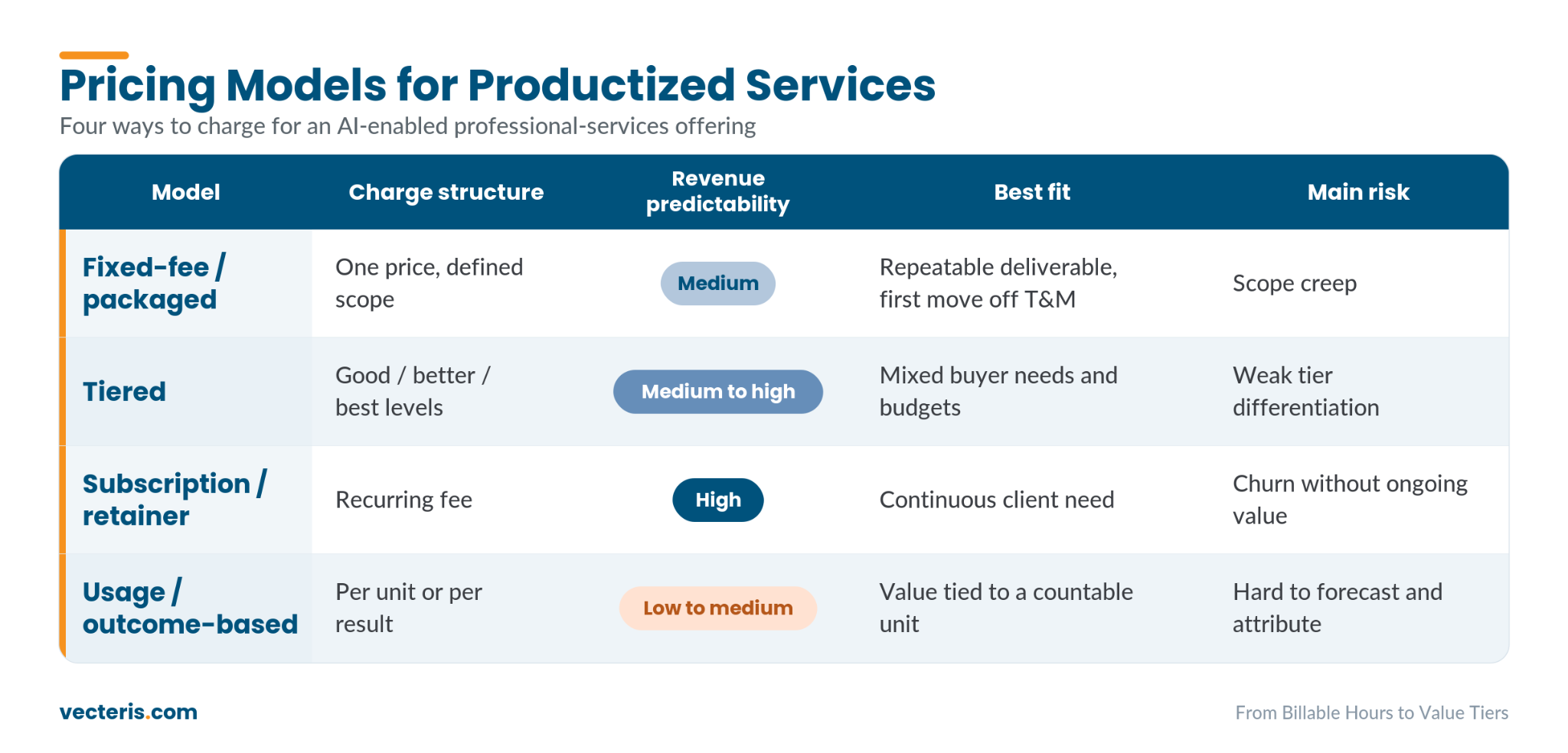
Once you know what your offering is worth, you choose how to charge for it. Four structures dominate productized professional services. Most firms end up combining two.
Model 1: Fixed-fee. One price for a defined scope and a defined outcome.
Fixed-fee is often the first step we see companies take into packaged pricing and is best used with well-defined, repeatable deliverables. Clients like fixed-fee because it is easy to buy. You will like it because it protects your margin when AI speeds delivery. The biggest risk comes from scope creep that eats margin when boundaries aren’t clearly set.
Model 2: Tiered (good / better / best). Two to four packaged levels at rising price and value.
Tiered pricing flexes based on your buyers’ needs and budget allowing you to more easily serve several segments. It is important to have clearly differentiated tiers or you risk confusing your buyer and stalling the sale. This is one of my favorite approaches because it clearly aligns your pricing and packaging to the value clients receive.
Model 3: Subscription. Recurring fee for ongoing access to a productized service or platform.
Subscription-based pricing is best when clients need continuous support and you can show recurring value. It is great for you because it is predictable, renewable revenue, and, as a result, many of our clients are working in this direction. We see many services organizations also use a version of this to sell ongoing managed services, essentially as a retainer model. The major miss is overlooking a customer success capability that focuses on unlocking client value and plans for the renewal from the start.
Model 4: Usage-based / outcome-based. Price scales with a unit of consumption.
Admittedly, we use this approach the least. Usage-based or outcome-based pricing is best used when value is directly tied to a specific, discrete item such as a report or a clear outcome you can measure and attribute. This approach is being used a lot these days with tokens. The problem we see companies run into is that usage-based pricing can be the hardest to forecast. When we are talking about outcome-based pricing, a percent of savings, for example, outcome attribution can be contested.
How to choose. A cheat sheet:
- Defined, repeatable deliverable, predictable cost: start with fixed-fee.
- Range of buyers and budgets: tier it.
- Continuous need: move toward subscription.
- Value tied to a countable unit or measurable result: layer in usage or outcome pricing.
And if AI is accelerating your delivery, any model beats Time and Materials, because all four decouple price from your hours.
How to Implement a Value-Based Pricing Framework
You do not have to rebuild your pricing overnight. Start where the risk is lowest.
- Pick one offering and a few trusted clients. Choose a recurring, well-defined piece of work and a high-trust relationship that will give you feedback, maybe even pilot with you.
- Define the outcome and the success metric. Write down what the client gets and how you will both know it worked.
- Choose the model. Use the decision guide above. For most firms making their initial move away from time and materials, that is fixed-fee or a simple set of tiers.
- Price it with the four inputs. Strategy, willingness to pay, full cost, competition.
- Run it as an experiment. Test, learn, adjust. This doesn’t have to be a one-time decision; testing with a “charter” group allows you to validate and pivot as needed.
Watch the common traps as you go: don’t oversell efficiency, or clients will expect steep discounts. Don’t change billing without adjusting internal incentives, or your team will fight the model. And do not skip the experiment phase.
Want to align your pricing model with your value model? Vecteris helps B2B professional-services firms productize expertise and price it for margin. Talk to us about reimagining your pricing model.
Additional Reading:
Time & Materials is Dead
The AI Transformation is a Business Model Transformation
Four Critical Inputs for Pricing your Productized Offerings
How To Mitigate Cannibalization Risk From New Products
Commercialize
Frequently Asked Questions
How to transition from hourly billing to value-based pricing effectively?
To transition from hourly billing to value-based pricing, firms should start by selecting one recurring service offering and piloting it with trusted clients. This process involves defining specific success metrics, selecting the appropriate pricing model, and testing the framework to validate willingness to pay before a full-scale organizational rollout.
Why is the time-and-materials model failing in the age of AI?
The time-and-materials model fails because AI accelerates delivery, which reduces the total hours logged on projects. Since revenue in this model is tied to effort, increased efficiency leads to lower invoices. This creates a structural paradox where firms are financially penalized for adopting productivity-enhancing technologies like Generative AI.
What are the key inputs for setting value-based prices?
Setting value-based prices requires four primary inputs: business strategy alignment, customer willingness to pay, full cost accounting including acquisition and retention, and competitive benchmarking. These factors ensure that pricing reflects the economic value delivered to the client rather than just the internal cost of labor or time spent.
How do tiered pricing models benefit professional services firms?
Tiered pricing models allow firms to reach broader market segments without discounting their high-end advisory services. By offering different packages, firms can convert one-off projects into predictable recurring revenue. This structure decouples firm growth from headcount, enabling service providers to scale their operations more efficiently without needing additional staff members.