
A Vecteris white paper for leaders who have proven that productized solutions work and are ready to build the structure to scale them.
Key Takeaways
- Product-led services firms require specialized organizational structures to successfully integrate scalable products alongside custom consulting.
- Dedicated senior leadership for the product portfolio is essential to drive growth and exceed performance goals.
- Choosing the right organizational model depends on strategic goals, desired speed, and product-service integration levels.
- Cross-functional squads eliminate operational handoffs by aligning diverse roles toward solving specific product-related business problems.
- Effective governance and ring-fenced funding protect innovation from being overtaken by immediate billable services work.
Executive Summary: Aligning Structure with Product-Led Growth
A product-led services firm is a professional services organization that integrates scalable, standardized products alongside its traditional custom consulting offerings. This model operates by shifting from a purely labor-based delivery system to one that uses technology-enabled solutions to drive recurring revenue. Optimizing organizational design and operating models is critical because traditional services structures often lack the dedicated resources and governance required to scale productized expertise. Understanding how to design organizational structures for product-led services firms is the key to transitioning from a project-based firm to a scalable business.
Organizational design and the operating model are the final components of a product-led transition to be implemented, often presenting the greatest challenge because they impact reporting lines and incentives. This paper provides a roadmap for that redesign, drawing on Vecteris's work with B2B services firms, the frameworks in our books Fearless and Commercialize, and research from Harvard Business Review and McKinsey.
Four principles carry the redesign: name one dedicated owner, choose the structure that fits your ambition, build cross-functional teams that kill handoffs, and protect and fund product work on its own terms. Artificial Intelligence (AI) changes the composition of the product team but does not alter the fundamental necessity of organizational redesign. We close with a phased process to get there in 6 to 12 weeks.
Identifying the Strategic Need for Organizational Redesign
Organizational redesign is a downstream decision that follows the successful validation of productized offerings. By the time structure is the question, the firm has already passed the readiness tests: a commitment of dedicated resources and measurable goals, and a willingness to test and iterate rather than mandate from the top. Firms that reach this point have done the hard work of proving the business model. The next constraint is no longer a better idea. It is how the firm is organized to build, sell, and support products alongside services.
Several indicators suggest it is time to transition from an informal setup to a formal product-led operating model. Products and standard consulting work begin to compete for the same senior people, and often the consulting work wins out for a variety of reasons. Siloed organizational structures often lead to redundant efforts where multiple teams build similar solutions without cross-functional visibility. Every launch slows at the handoffs between functions. No single person is accountable for the portfolio. In Fearless, Vecteris co-founder Eisha Armstrong puts the principle plainly: structure should flow from and support the product vision, and it has to change as the firm matures. Jennifer Yeazel, COO of Precision eControl, names the stakes from her own experience at the law firm Vorys: "Having a structure that is aligned with the growth stage, that's the difference between organizations that have productized well and others that are struggling to keep growing."
The reframe matters. Redesigning the org is not a fire drill. It is a sign you have outgrown the structure that got you here, which is exactly where a maturing product-led firm should be.
Why Pilot-Stage Structures Fail to Support Scalable Productization
The informal organizational setup used to validate initial products cannot effectively manage a diverse product portfolio. A borrowed product lead, a few willing specialists, and engineering capacity scraped together between client deadlines were enough to validate that clients would buy a productized offering. That same model breaks the moment you run more than one or two products, because now the work competes for time, budget, and attention, and there is no structure to settle the competition.
Two failure modes show up again and again. The first is treating the redesign as a hiring problem. As one CEO of a business services company told us, you cannot hire your way to a new culture. New product talent cannot fix a structure that still rewards utilization over building. The second is assuming the move is mechanical. In our work, the leaders who struggle most underestimate how much the transition asks of the organization: entrenched services experts resist giving up client access for product testing, risk-averse leaders protect proven services over uncertain products, and the playbook borrowed from tech-native companies does not transfer to a services business with a different model and a different relationship to its clients. None of that is solved by a new box on the chart. It is solved by a structure, clear ownership, and an operating model designed for the work product actually requires.
Principle 1: Appoint Dedicated Senior Leadership for the Product Portfolio
Before modifying reporting lines, firms must appoint dedicated owners for the product portfolio. Not a committee, not a side-of-desk assignment, not a task force that meets on Fridays. At minimum, one relatively senior person with strong product skills, dedicated to the portfolio.
Data from the Vecteris 2025 Productization Benchmark Survey indicates that firms with dedicated product leadership are 36 percent more likely to exceed their goals. Dedicated leadership focus is the primary differentiator between a product portfolio that scales and one that remains stagnant.
Fearless describes this owner as the quarterback. Often a Head of Product, this person identifies market opportunities, sets the roadmap, and coordinates the roles a strategy needs. The core product skills are consistent: spot opportunities from data and pattern recognition, translate them into a workable design and financial plan, guide product functionality, define how the product reaches the market and sells, read usage data, and keep customers and staff engaged with a changing product. In a services firm, one skill matters more than it would at a tech-native company: stakeholder management. The owner has to win the trust of delivery leaders, sales, and senior partners who have spent careers selling custom work. Strong storytelling helps more than technical depth. One product leader told us: “a good story about how the product changed our client's business does more to clear internal friction than any feature list.”
Where do you find this person? Early on, an internal rotation often beats an external hire. An internal leader knows the political terrain and the existing offerings, and can be supported by contracted or junior product talent. The tradeoff is real and worth naming: internal people know the firm but may lack product depth and become flight risks once trained, while external hires bring product experience but are hard to attract, hard to retain, and new to the nuances of a services business. Fearless recommends holding off on an external Head of Product until there is some validation of product-market fit. When you do hire externally, design the role to attract the talent you want. One Chief Product Officer filled a hard-to-fill role by scoping it around innovation and strategy rather than writing user stories and grooming a backlog, which made it far more appealing to in-demand product professionals.
One more decision sends a signal whether you intend it or not: where the owner sits. Joe Terry, CEO at Culture Partners, found his firm needed the Head of Product on the executive team. "This elevated the product team, giving them a seat at the table in all conversations, which wasn't the case before." Product reporting under a CIO or CTO reads as a technology effort. Reporting under marketing reads as messaging. Placement is a statement of intent.
Principle 2: Select an Organizational Structure Aligned with Strategic Goals
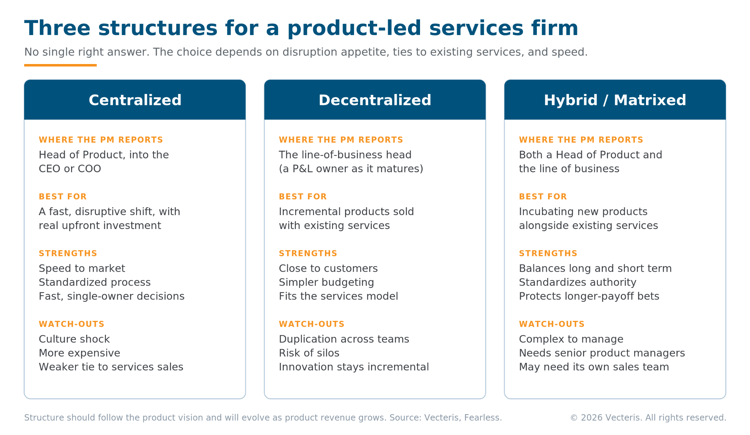
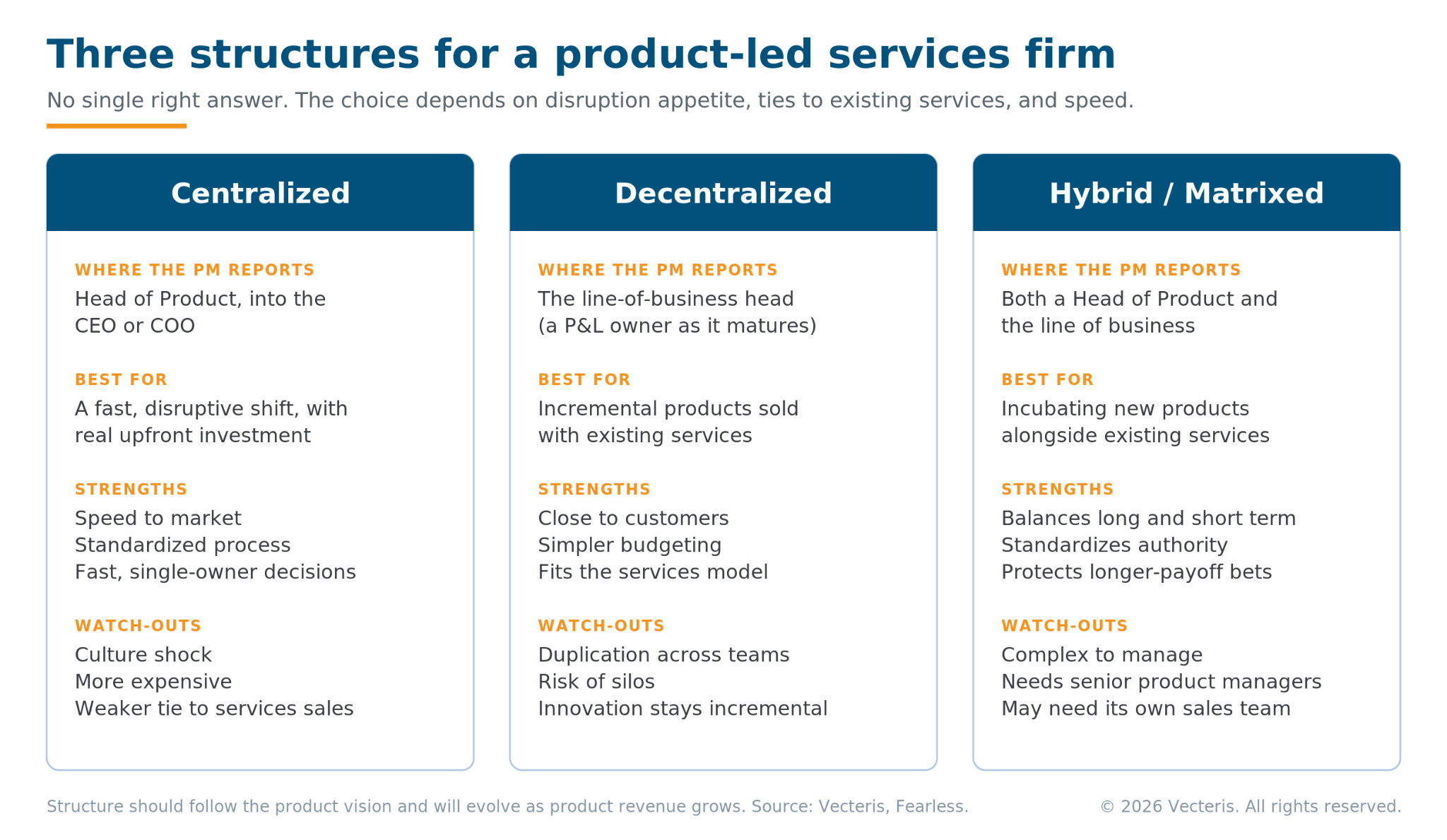
There is no single right structure. The choice follows three questions: how much disruption you want, how tightly products tie to existing services, and how fast you need to move. In Fearless we lay out three models, each with a clear best fit.
Centralized Structure. A centralized structure establishes a distinct product function with the same standing as other major corporate departments. Product managers report to a Head of Product, who reports to the CEO or COO. Decisions move fast because authority sits with one leader and the language and processes are standardized. This model wins on speed to market and is best for firms that want a sharp, accelerated shift, intend to disrupt their market, and are prepared to make a large upfront investment.
Decentralized Structure. A decentralized structure places product functions within individual lines of business, allowing product managers to report directly to division heads. Products stay close to existing customers and bundle naturally into services, and divisions control their own budgets. This is the right fit for firms developing incremental products sold as part of existing services, and for mature firms where products are already a large share of revenue. The risk is duplication and silos, since it is harder to see across the firm, and innovation tends to stay incremental.
Hybrid or Matrixed Structure. This model utilizes a dedicated product department led by a Head of Product, plus product managers embedded in the lines of business who report into both. This model standardizes authority and process while keeping products tied to division needs, and it is the most effective choice for firms that want to incubate new products while still selling products alongside existing services. The tradeoffs: it takes more time to manage competing priorities, it demands more experienced and politically capable product managers, and it may require a dedicated product sales team while products gain traction in the existing channels.
A related decision: in more mature firms, developing new products and managing existing ones are separate functions that can be organized differently. Some firms set up a new-product incubator with its own budget, so funding for new products does not compete with funding for the established portfolio. A useful lens is McKinsey's Three Horizons framework from The Alchemy of Growth. Endemic innovation that sells to existing markets (Horizon 1) can sit with the lines of business. Peripheral innovation with a longer payoff (Horizon 2) is best incubated centrally. Pure new-market bets (Horizon 3) are also best pursued centrally, often through partnerships.
Whatever you choose, expect it to evolve. If you are going big now, a centralized, incubated structure makes sense to start, shifting toward decentralized as product revenue grows. If you are starting slow with plans to accelerate, a matrixed model can work at the outset, with a move to centralized when it is time to speed up. Vorys ran product responsibilities across a matrix while testing whether its eControl solution had product-market fit, with IT providing development, firm marketing providing product marketing, and a cross-functional team providing product management. Once fit was confirmed, the firm stood up a standalone line of business with its own product, development, and marketing roles.
The principles we apply when helping a firm choose: align the structure to the firm's goals for what product means to the business, minimize disruption with a phased approach where the risk is high, and create clear authority so everyone knows who decides.
Principle 3: Form Cross-Functional Squads to Eliminate Operational Handoffs
Structure sets reporting lines. The operating model decides whether products ship. The goal is to move a product from discovery to launch without it being handed across silos, losing context and speed at every pass. The single most useful pattern, regardless of reporting relationships, is the squad: a small group drawn from different parts of the firm where each person owns a piece of the work and the group comes together to solve one product problem.
The team that does this has a recognizable shape. A senior product manager or director owns the portfolio and go-to-market accountability. A product manager owns the roadmap, the voice of the customer, the business case, and product-market fit. Product analysts handle market analysis, performance, and requirements. On the build side, a small engineering team, typically two to four engineers per product with quality assurance at a two-to-one or four-to-one ratio, sits alongside a project manager and, where needed, a business analyst and a UX designer that can be embedded or outsourced early. Product contributors and subject-matter experts from delivery, operations, and marketing round out the group. Two-track versions split a discovery and go-to-market team from a build team, joined at the product manager.
Equally important is naming the roles you do not need yet. The product capabilities (product management, product development, customer success, product marketing, go-to-market support, and product review) grow over time, and the skills required grow with them. One full-time product manager is the only true must-have at the start; engineering is often outsourced early, and most other roles are added as the strategy matures. Resist copying a full SaaS org chart into a firm with two products.
Make decision rights explicit. Every person on the team should be able to answer a short set of questions: what they are accountable for, what decisions they own, what they are expected to deliver, and who to go to for a decision they do not own, for coaching, and to remove a roadblock. When those answers are clear, handoffs stop being the place where work dies.
One role deserves special attention: product sales. Selling products bundled with services is harder than most leaders expect. As one COO of a global IT consulting firm told us, "Selling at scale is just so different." Productized selling requires value-based selling rather than cost-plus, the ability to drive renewals and expansion, and the skill to demonstrate value inside the sales process. In services-first organizations, you may need a dedicated product sales team while products gain traction in the existing channels. Commercialize makes the point: a product sales motion misaligned with the firm's legacy approach is one of the most common reasons good productized solutions stall after launch.
Principle 4: Establish Governance and Funding Models to Protect Innovation
A structure on paper means nothing if the work that pays the bills today keeps reclaiming the team tomorrow. In a services-first firm, that pressure is billable work winning the moment utilization dips. It can still happen in more product-forward firms when teams slip back into old habits, for example, building around the needs of one client rather than serving a broader strategy. Either way, product work loses by default unless two mechanisms protect it: governance and funding.
Product governance provides a structured framework for decision-making and resource allocation. The most common tool is a regular product review, a council that assesses the portfolio, evaluates new ideas, and allocates resources. The council works best when it is cross-functional, including delivery, sales, marketing, and even HR, and when accountability is unambiguous. There should be exactly one accountable person in the product vertical, typically the Head of Product, who holds the go or no-go decision for the budget area. Korn Ferry built this into a competitive advantage. Anyone in the firm can bring a product pitch with a high-level business case to a quarterly Product Concept Commit meeting; an Implementation Council then allocates resources and funding. As Christoffer Ellehuus, President at Korn Ferry Digital, put it, well-designed governance does a lot of the change management for you, because it shows you "who is willing to raise their hand, come on board, become true believers, and take that back to their own teams."
Governance also forces the hardest discipline: stopping work that is not working. In our experience, the biggest governance pitfall is not killing enough ideas or sunsetting weak products. Heather Ryan, Global Product Leader for Mercer's Career practice, is direct about it: "Not everything can get big funding every year. You have to have a finger on the pulse on where the long-term opportunity is, which may mean sunsetting products that are at the tail-end of their maturity." The risk to avoid on the other side is innovation theater, where an overdesigned process produces meetings instead of decisions.
Funding is the other lever, and it is where many redesigns quietly fail. When innovation budgets get set during annual planning, the uncertain returns of new products lose every fight with proven services. The fix, as Eisha Armstrong lays out in our work on innovation budgeting, is to separate innovation governance from operational budgeting. A Product Innovation Council prioritizes investment across the Three Horizons, insulating product bets from the operating budget. Leading firms go further with ring-fenced innovation funds: Deloitte's 2023 Tech Trends found the highest performers protect more than a third of their innovation budget for transformational (Horizon 3) bets, kept separate from corporate and business-unit budgets so they survive cost-cutting cycles. And rather than fund a year at a time, the strongest firms use metered funding borrowed from venture capital, releasing budget in tranches as teams hit learning milestones. One Vecteris client set $25K, $50K, and $150K tranches with predefined exit criteria, which produced faster iteration and more disciplined investment. The budgeting process is not a finance exercise. It is the strategy, expressed in where you are willing to spend.
How Artificial Intelligence Influences Organizational Design for Productization
Artificial Intelligence (AI) changes the composition of the product team but does not alter the fundamental necessity of organizational redesign. Two effects matter for org design. First, AI is becoming a part of everyone’s job in product and removes effort inside existing roles, shifting who you need as well as roles and responsibilities. For example, today prototyping might sit better with product teams vs. engineering teams. Second, AI is creating new work tied to building and monetizing AI-enabled products. Someone has to own how AI shows up in the offering, judge the quality of its output, manage the data and prompts behind it, and decide how the firm prices and packages what AI now makes possible. Some of that is a new responsibility added to an existing role. Some of it is a new role entirely. The question for the org chart is where each piece sits and who is accountable for it. Design the structure around the new roles AI creates, alongside the existing ones it makes faster.
The deeper shift is cultural, and it has structural consequences. As we have written, the firms gaining traction with AI are not handing out logins. They are training people to be "agent bosses," able to assign work to an AI agent, refine the output, judge the quality, and iterate. That demands protected time to learn and a redefinition of value around outcomes rather than hours, both of which are design choices a leader makes when setting up the team. The cultural hurdles are predictable: a perfectionism that will not ship a draft, fear of being replaced, and skill gaps that require real investment to close. Treating AI as a tools rollout, owned by IT or an innovation lab, misreads the change. It is a business-model change, and the org has to be built for it.
A Phased Roadmap for Redesigning the Product-Led Operating Model
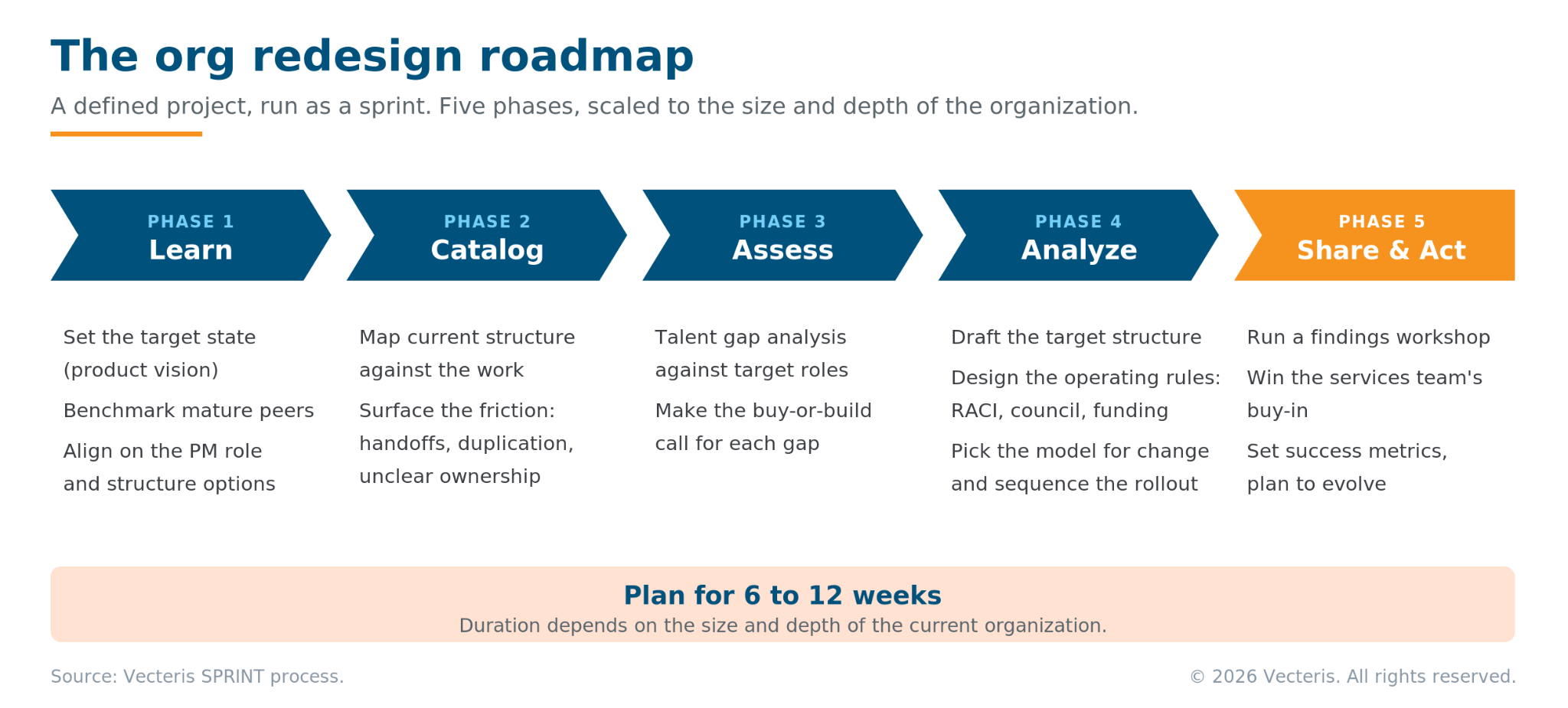
Redesigning the org is a defined project, not a decision made one afternoon at an offsite. Vecteris runs it as a sprint, scaled to the size and depth of the organization, over 6 to 12 weeks. The five phases include:
- Learn. Align on the role of the product manager and the structure options on the table. Two moves matter most here. First, set the target state: agree on the product vision and strategy as well as what “product” means to the firm, because the structure flows from that, and a redesign without a destination becomes an org-chart exercise. Second, benchmark against firms a step ahead. Study how a more mature peer is organized and calibrates everything downstream, from roles and reporting lines to team ratios and governance cadence.
- Catalog. Map the current structure and team against the work the product strategy actually requires, and make the friction explicit. Name where handoffs could slow launches, where teams duplicate effort, and where ownership is unclear. This is the evidence that justifies the change and points to what the new structure has to fix.
- Assess. Run a talent gap analysis against the roles the target model needs, not a headcount review. For each gap, make the buy-or-build call: an internal rotation who knows the firm, or an external hire who brings product depth. Tie the decision to where you are on product-market fit.
- Analyze. Synthesize the findings and draft the target structure, then design its operating rules into the same draft. A structure is complete with decision rights attached: the RACI, the product council, and the funding model that protects product work. This is also where you choose your model for change and sequence the transition in phases that limit disruption.
- Share and take action. Run a findings workshop, align stakeholders across the firm, and commit. Treat winning the broader team's buy-in as its own workstream, not a line in the closing deck. Korn Ferry's lesson holds: a well-designed, inclusive process does much of the change management for you. Close by defining how you will know the structure is working, and set the expectation that it will evolve as product revenue grows.
How you approach the change is its own choice, and Fearless describes three models. You can hire or acquire pacesetters to set a new pace fast, accepting the risk that fast-movers suffer organ rejection if leadership does not back them. You can incubate product as a separate organization, as AMEND Consulting did when it spun Batched.io into its own business with its own CEO, sales, and customer success, which speeds time to market but makes it harder to use the existing sales channel. Or you can create a movement, setting the vision and behaviors first and building buy-in before changing structure, which is less disruptive and less capital-intensive but slower. Many firms blend them. Amy Pyles, President of O4G Group, described building "a walled garden for a product leader to operate in" while keeping her plugged into the leadership team, a hybrid of incubation and movement.
Set expectations on the timeline for change. The structure is a starting point, not a finished state, and the best leaders treat it as fluid because goals change. Governance discipline, in particular, tends to show real improvement six to twelve months in, not overnight.
Common Pitfalls in Organizational Redesign and Implementation Steps
The failure modes are consistent, and most are avoidable:
- A part-time or borrowed owner instead of one dedicated, senior leader.
- Billable work that overrides product the moment utilization dips.
- A structure copied from SaaS and dropped onto a services firm.
- Innovation budgets left exposed to the annual operating plan, with no ring-fenced or metered funding.
- Decision rights left vague, so handoffs become the place work dies.
- Governance that produces meetings instead of decisions, and never kills a weak product.
- A "movement" with no executive backing, which becomes, in one CEO's words, a slog.
If your firm is product-led and feeling the friction this paper describes, the next step is to see clearly where you stand. Vecteris's Product Innovation Maturity Diagnostic shows where your structure, talent, and governance sit today and what to change first. Start there, or reach out and we will help you map the redesign.
Take the Product Innovation Maturity Diagnostic or get in touch with Vecteris.
Frequently Asked Questions
What is the best way to design organizational structures for product-led services firms? Designing organizational structures for product-led services firms requires aligning reporting lines with product vision rather than traditional service delivery. Leaders must appoint dedicated owners, form cross-functional squads to eliminate handoffs, and establish separate governance models to protect innovation from being consumed by billable consulting work.
How do you balance product innovation with existing services? Balancing innovation with services requires separating the governance and funding of new products from the operational budget. By using ring-fenced innovation funds and a dedicated Product Innovation Council, firms can protect long-term product bets from the immediate pressure of billable utilization, ensuring that transformation initiatives survive annual cost-cutting cycles.
Why should product leadership sit on the executive team? Product leadership should sit on the executive team to elevate the product strategy and provide it with a seat at the table. This placement signals intent, ensures that product goals are integrated into firm-wide decision-making, and prevents the product team from being relegated to a secondary technology or marketing function.
What is the role of cross-functional squads in productization? Cross-functional squads serve as the primary operating model for moving products from discovery to launch without losing speed at organizational silos. By grouping engineers, analysts, and product managers together to own specific product problems, firms can replace inefficient handoffs with clear accountability and improved decision-making across the entire product lifecycle.
Additional Reading
- Eisha Tierney Armstrong, Fearless: How to Transform a Services Culture and Successfully Productize.
- Eisha Tierney Armstrong, Commercialize.
- Before You Productize: What Every Services Firm Needs in Place.
- How to Set and Allocate an Innovation Budget That Actually Drives Growth.
- Agent Bosses, Not AI Users: The Cultural Shift B2B Firms Must Embrace.