

Productization in professional services is the process of transforming customized, human-led expertise into standardized, scalable products or platforms. This strategy involves packaging intellectual property—such as data analysis methodologies or proprietary databases—into discrete offerings that can be sold independently of consultant hours. By decoupling revenue from headcount, professional services firms can improve profit margins and achieve faster growth than traditional service models allow. Learning how to productize professional services effectively is a critical step for firms looking to break the link between labor hours and revenue.
Vecteris maps this shift with the Product Innovation Ladder, a four-stage framework that runs from customized services to productized services, products, and products-as-a-service. For the current, expanded version of this thinking, see the Vecteris complete guide to productization.
Key Takeaways
- Productization transforms customized, human-led expertise into standardized, scalable digital or physical product offerings.
- Decoupling revenue from headcount allows professional services firms to achieve significantly higher profit margins.
- The Product Innovation Ladder provides a framework for evolving from customized services to subscription-based products.
- Productized services offer customers a fixed price and predefined features, reducing the need for intervention.
- Products-as-a-service models enable ongoing revenue through subscriptions, similar to established software and technology companies.
Imagine you run a marketing consulting firm that uses a market intelligence database and data analysis methodology as part of its highly customized consulting engagements. But you are finding that it’s hard to grow. The problem is the firm can only grow revenue as fast as it can add and train staff (especially if you want to maintain the quality of service you are known for in the industry). Adding people is slow and expensive.
However, your firm could grow its revenue and improve its profit margin by offering that database and data analysis as a “product” for companies to subscribe to and access through a self-service portal. You could package the database and data analysis methodology into a product to be sold alongside the less scalable customized service of your consultants’ time.
This transition from bespoke consulting to a subscription model is a real-world example of productization, a strategy increasingly adopted by consulting firms, agencies, and other professional services providers.
In the context of B2B professional services, a product is a scalable, often tech-enabled tool or program that can be standardized, packaged, and sold as a standalone unit. Just like a tube of toothpaste that you might buy at a store, a product has a name, a predefined set of features and benefits, and a set price. For example, content (e.g., research report, book), an event (e.g., training course, conference), software that automates a process or algorithm, or a unique data set.
It helps to understand the different flavors of productization available to business services firms. The Product Innovation Ladder is a framework designed to map how an organization that provides customized services could evolve to also provide scalable products:
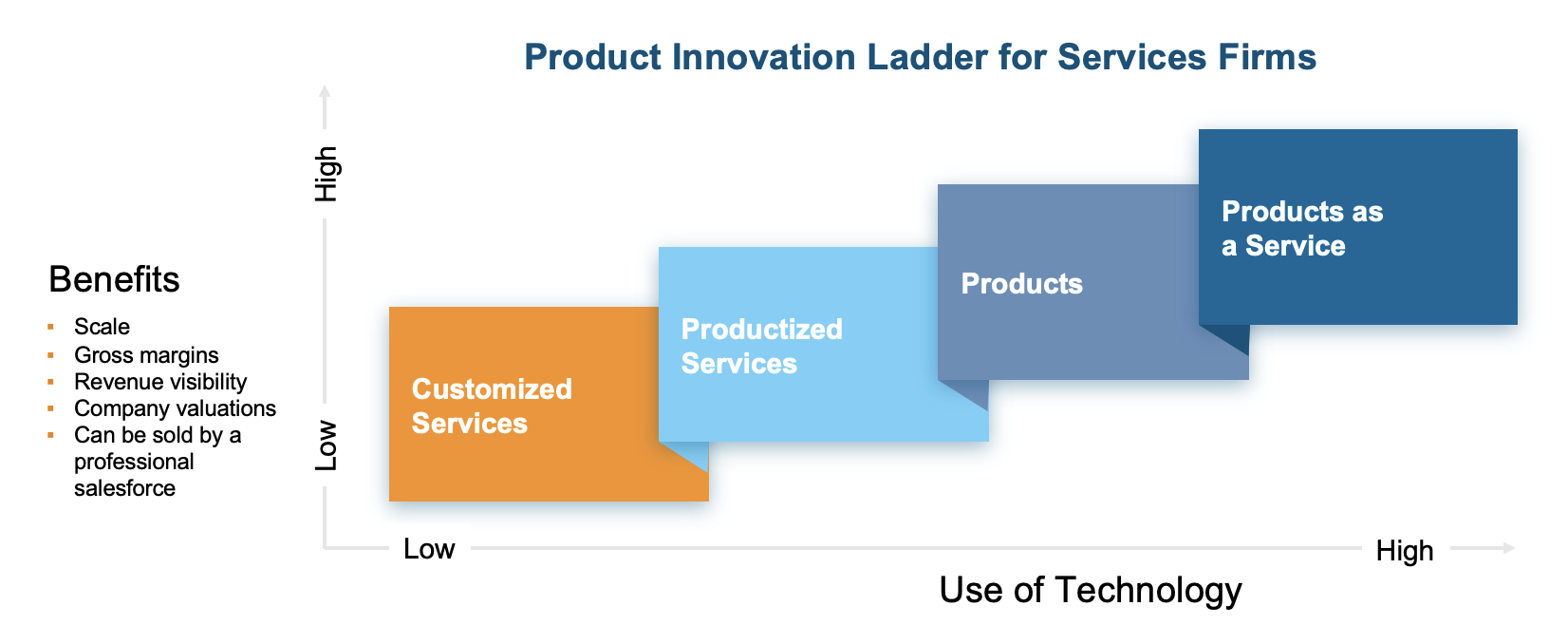
As a professional services firm moves from customized services in the lower left, to products-as-a-service in the upper right, the use of technology tends to increase as do the benefits, such as improved gross margins, better revenue visibility, and increased company valuation.
When evaluating the financial impact of productization, consider this data point:
"Consultancies, law firms, ad agencies, and other professional services firms struggle to nudge their gross margins above 40% as they achieve scale. Contrast that with product companies like Google and Adobe, which don’t have to deal with the same cost structure and which enjoy gross margins of 60% to 90%." -Mohanbir Sawhney (HBR, September 2016)
It is important to note that organizations do not have to move through each phase, but many organizations do follow this progression.
How the Product Innovation Ladder Categorizes Service Evolution
Starting in the lower left, customized services are human-resource intensive, knowledge-led services. Customized services can be lucrative but they are hard to scale because it requires additional people to serve additional clients. It’s very “hands-on” and key-person dependent. The consultant or partner or principal or account director tends to be what clients are buying.
Productized services are human-resource intensive but standardized offerings where all customers receive the same experience at a fixed price. The service is broken down into its core components, which are sold as a defined package of services, such as the marketing example above. Productized services still require additional people to scale, but should require fewer both to sell and to deliver.
For example, WP Curve (later bought by GoDaddy) productized WordPress consulting by offering a package of website building or website fixing services. Instead of working one-on-one with a consultant to build or repair a company’s website, customers buy the package of services they need (at a fixed price) and the WP Curve team goes off to build or repair the site on their own.
The third phase of the Product Innovation Ladder involves products that deliver value without requiring human intervention for delivery. The list of potential products here is almost endless but common ones that our clients develop are books, asynchronous training courses, data files or syndicated research reports.
For example, one of our clients, lean strategy consulting firm The Garage Group (TGG), recently launched a series of syndicated reports. They noticed that many clients were commissioning market research on similar topics. TGG decided to create syndicated research reports that could be used by multiple companies, reducing the cost and research time for their clients.
Products-as-a-service (PaaS) represent the highest tier of the ladder, where standardized information or tools are delivered on an ongoing basis, typically through a subscription model. Using the industry trends report example, instead of the customer buying just one report, a customer pays a subscription fee to access a series of reports or supplemental data to complement the reports. The service is the ongoing supply of information to the customer and the product is the standardized information itself. Many services firms are developing subscription-based technology platforms that are designed to be consumed alongside their traditional consulting services.
For example, Accenture’s AIP+ service blends traditional consulting with a collection of artificial intelligence (AI) technologies. AIP+ is a cloud-based platform through which Accenture’s clients can install AI tools and applications from a network of partner vendors, effectively offering “AI as a service.” By partnering with technology vendors, Accenture benefits from being able to offer AI as a service without having to invest in the engineering resources to develop those technologies in-house. Similarly, Accenture’s technology partners gain access to new clients and markets without having to sell their services themselves.
Assessing Organizational Readiness for a Productization Strategy
Before implementing a productization strategy, I highly recommend assessing your organization's product innovation and launch capabilities by taking our Product Innovation Maturity Diagnostic. Our Product Innovation Maturity Diagnostic will help you better understand your team's product innovation strengths and weaknesses and identify the capabilities you’ll need to successfully pursue a productization strategy. Feel free to reach out to explore how Vecteris can help you identify your productization opportunities and next steps.
Note: This is an update on one of our earlier blogs. You’ll see some of the same ideas there, but we’ve expanded on them in this blog. That said, we shared some strategies about how you might approach productization that you might find useful to consider. Read more here.
Frequently Asked Questions
What are the primary benefits when you learn how to productize professional services?
Learning how to productize professional services allows firms to decouple revenue from headcount, which improves profit margins. This strategy enables faster growth, better revenue visibility, and increased company valuation compared to traditional consulting models that rely heavily on human-resource intensive service delivery.
What is the Product Innovation Ladder?
The Product Innovation Ladder is a strategic framework that maps the evolution of a firm from customized services to scalable products-as-a-service. It helps organizations transition from human-led, key-person dependent services toward standardized offerings and subscription-based models that utilize technology to deliver value without constant human intervention.
How do productized services differ from customized consulting?
Productized services are standardized offerings where all customers receive the same experience at a fixed price. Unlike customized consulting, which requires significant human-resource intensity for every engagement, productized services break down core components into defined packages, making them easier to sell and deliver at scale.
What is products-as-a-service in a professional services context?
Products-as-a-service represents the highest tier of the Product Innovation Ladder, where firms deliver standardized information or tools on an ongoing basis via subscription. This model allows professional services firms to provide continuous value to clients through technology platforms, effectively shifting from one-off projects to recurring revenue streams.